The Storage Habits That Make Your Home More Stressful and What to Do Instead
When a home feels stressful, most people assume the fix is more storage.
But storage itself is often the quiet problem, because how you keep things matters as much as how much you own.
You can have a home that looks tidy and still feels draining, purely because of a few storage habits that make daily life harder than it needs to be.
And there’s real weight to this beyond the feeling.
In one UCLA study, women who described their homes as cluttered and full of unfinished tasks tended to have less healthy daily patterns of the stress hormone cortisol than those who described their homes as restful.
Clutter isn’t only something you see, in other words, it can sit on your nervous system all day.
The reassuring part is that most of that stress comes from a handful of fixable habits, not from the amount of stuff itself.
Here are the storage habits that quietly wind you up, and what tends to work better.
Storing Things Nowhere Near Where You Use Them
This is the invisible one, because each instance is tiny.
The batteries live in the bedroom but the remote is in the lounge, the spare bin bags are upstairs from the bin, the scissors are three rooms from where you ever need them.
Every mismatch is a small daily friction, and a home full of them feels quietly exhausting without you ever knowing why.
Store things where you actually use them, even if that means keeping the same item in two places.
A second cheap pair of scissors in the kitchen drawer removes an annoyance you were paying several times a week.
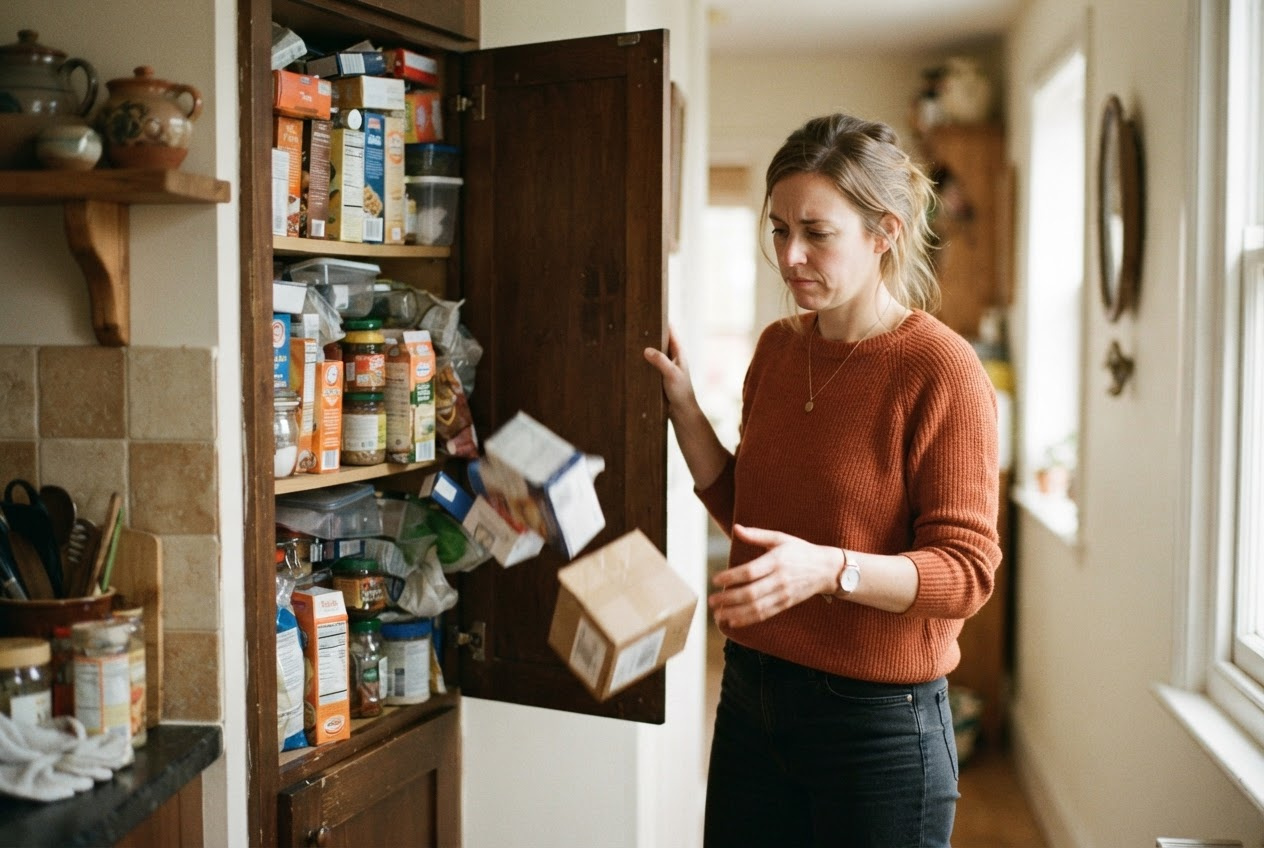
Stacking Things Two and Three Deep
The moment something goes behind something else, it effectively disappears.
You forget you own it, you buy another, and reaching the back means unstacking the front, so you simply stop.
Deep shelves and stacked bins feel efficient but they hide half of what you own from you.
Aim to store things one layer deep, where you can see everything at a glance.
If a cupboard is too deep for that, use a pull-out tray or a basket you can slide out whole, so the back isn’t a place things go to be forgotten.
Hiding Everything in Opaque, Unlabelled Bins
Matching boxes look calm on a shelf and turn your home into a memory test.
If you can’t see inside and there’s no label, every box becomes a small mystery you have to open to solve.
Over time you forget what’s in them entirely, which is how people end up with three of something and none of another.
Either use clear containers, or label the opaque ones on the side you actually see.
The goal is to know what you own without opening anything, because unseen almost always becomes unused.
Over-Organizing Until Putting Things Away Is a Chore
There’s a point where a storage system becomes so detailed that maintaining it is its own job.
If every item has a labelled sub-compartment, then putting a single thing away means deciding, sorting, and reopening three lids.
So you don’t, and the elaborate system collapses into a pile on top of itself, which feels worse than no system at all.
Give things simple, generous homes instead: a drawer for a category, not a labelled slot for each object.
A home you can tidy into in one careless second is a home you’ll actually keep tidy.
Keeping Every Surface and Open Shelf Full
Open shelving and full surfaces look homely and quietly tax your attention.
Researchers at Princeton found that visible clutter competes for your focus, so a room full of things on show is a room gently pulling at you the whole time you’re in it.
Every object in your eyeline is a small unfinished thought, even if you’ve stopped consciously noticing it.
Keep your most-used surfaces as clear as you can, and let cupboards and drawers do the holding.
Save open shelves for a chosen few things you genuinely like to look at, not as overflow parking for everything else.
Letting Things Live With No Home at All
The real source of the doom pile is items that never got a designated spot.
Anything without a home migrates to whatever surface is nearest, which is why the same chair, counter, or table collects clutter no matter how often you clear it.
The mess isn’t a discipline problem, it’s usually a housing problem.
Give every category one specific home, and the wandering stops, because there’s finally somewhere obvious for each thing to go.
The pile that keeps returning to the same spot is just telling you those items don’t live anywhere yet.
Giving Your Best Storage to Things You Rarely Use
Look at your easiest-to-reach shelf and there’s a fair chance it holds something you touch twice a year.
When rarely-used things occupy the prime, arm’s-reach spots, the things you use daily get squeezed into awkward corners, and daily life gets a little harder every day.
Storage real estate should follow how often you reach for something, not how big or old it is.
Put daily items at the easiest height and reach, and send the seasonal and rarely-used things up high or to the back.
It’s a five-minute reshuffle that quietly removes friction from every single day.
The Paper You’re Keeping “to Deal With Later”
The growing stack of mail, forms, and letters is one of the most common standing sources of low-level stress in a home.
It sits in your eyeline as a visible pile of unfinished decisions, and each glance is a small reminder that something’s undone.
Give paper one tray and a two-minute daily habit rather than a spreading heap.
Open mail standing over the recycling, so most of it never lands in the house at all, and put the few things that need action in the one tray you actually check.
Why This Matters More Than It Seems
None of these habits is dramatic on its own, which is exactly why they go unexamined.
Together, though, they turn a home into a place that asks small things of you all day, and that low, constant asking is what reads as stress.
Fixing them isn’t about owning less, though that helps too, which is really the wider point about minimalism.
It’s about making the things you keep easy to see, reach, and put away, so your home stops working against you in a dozen quiet ways.
The Point
A stressful home usually isn’t a sign you need more storage.
More often it’s a few habits making what you already own harder to live with than it needs to be.
Store things where you use them, keep them visible and one layer deep, give every category a home, and keep your surfaces and your best shelves for the things that earn them.
Do that, and the house gets quieter to be in, without a single extra box bought.
Frequently Asked Questions
Can too much storage actually make a home more stressful? Yes. More storage often just lets clutter spread and hide, and poorly organized storage adds daily friction. How you store things — visible, reachable, close to where you use them — matters more for stress than how many containers you own.
Does clutter really affect your stress levels? There’s evidence it does. A UCLA study found that women who described their homes as cluttered and full of unfinished tasks tended to have less healthy daily cortisol patterns. Separate research from Princeton found visible clutter competes for your attention and makes focus harder.
Why can’t I keep my surfaces clear no matter how often I tidy? Usually because the items landing there have no proper home. Things without a designated spot drift to the nearest surface. Give each category one specific home and the same counter or chair stops collecting clutter.
What’s the best way to store things so I actually find them? Keep everything one layer deep and visible, use clear or clearly labelled containers, and store items where you use them. If you can’t see what you own without opening or unstacking things, you’ll forget it and often rebuy it.
Should everyday items go in the easiest-to-reach spots? Yes. Storage should follow how often you use something. Put daily items at arm’s reach and send seasonal or rarely-used things up high or to the back. Doing it the other way round adds friction to every day.
How do I stop the pile of paper and mail from building up? Give it one tray and a two-minute daily habit. Open mail over the recycling so most never enters the house, and put the few things needing action in a single tray you check regularly, rather than letting it spread across surfaces.